Accessibility, Awe, and Interpretation in Contemporary Museums
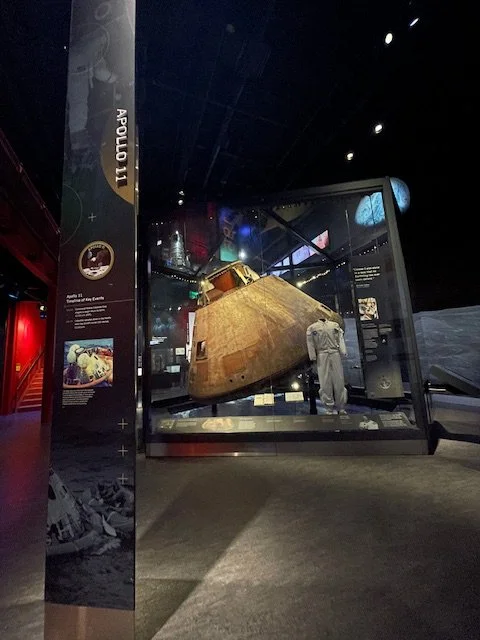
Smithsonian National Air and Space Museum,
If there is concern about the future of museums, about whether they are truly evolving in ways that serve visitors meaningfully, my observations today seemed promising. Across three very different conversations, I encountered a shared direction in contemporary museum practice: museums are increasingly designing for the full visitor encounter (how people enter, navigate, feel, understand, and connect), rather than treating exhibitions as static displays of expert knowledge.
Rethinking Access at the National Air and Space Museum
The day began at the Smithsonian National Air and Space Museum, where a long-term building transformation has become an opportunity to rethink the visitor experience.
What started as a structural issue with the museum’s exterior façade opened the door to something larger: reconsidering how stories are told, how visitors move through exhibitions, and how accessible those experiences truly are.
One of the most important shifts described by staff was the evolution of exhibition teams. Instead of being primarily curator-driven, exhibition development now involves collaborative teams that include educators, designers, accessibility specialists, and permanent visitor researchers.
Accessibility is approached broadly. It includes tactile models, audio descriptions, QR-supported navigation for blind and low-vision visitors, seating and circulation for wheelchair users, and quieter spaces for visitors with sensory sensitivities.
Equally important is a change in spatial design. In this line, Shannon Baldidi, Manager of the Youth and Teacher Program, and Ashley Hornish, museum exhibit designer, explained that, instead of directing visitors along a single linear route, the NASM redesigned its galleries to offer greater freedom of movement and multiple entry points to the content.
Studying Awe as a Museum Experience
National Gallery of Art, celebrating the 250 years of America!
Later, at the National Gallery of Art, the conversation about visitor experience took on another lens: emotion.
Nathalie Ryan, Senior Educator for Learning & Engagement; Cassandra Anderson, Interpretive Programs Manager; and Paula Lynn, Head of Visitor Evaluation, shared part of the museum’s ongoing research collaboration with scholars at the University of California, Berkeley, exploring the role of awe in museum settings.
Psychologist Dacher Keltner (1) describes awe as the feeling we experience when encountering something vast, something that stretches our understanding of the world. While we often associate awe with dramatic moments, such as standing before a monumental landscape or an extraordinary work of art, the research presented suggested that awe can also emerge through quieter acts of attention.
The museum's workshops study invites visitors to slow down and spend extended time with a single artwork while reflecting on their own experiences of awe. Participants frequently report feeling calmer, more curious, and more connected to others by the end of the experience.
Listening to this discussion, I was struck by how relevant the idea of awe is beyond the museum gallery. The feeling can emerge in unexpected places. As a wildlife and macro photographer, I can attest to the joy of noticing the intricate pattern of a leaf during a walk, watching a flock of birds shift direction in the sky, or simply pausing long enough to observe details that normally pass unnoticed.
In that sense, the museum becomes not only a place where awe can be experienced, but also a place where visitors can practice noticing, a habit that can extend well beyond the gallery walls.
Experimenting with Participatory Interpretation
In the museum’s American galleries, interpretation itself is becoming a space for experimentation. Just a few years ago, the West Building had very little interpretive text. Today, the museum is exploring multiple forms of engagement designed to encourage deeper interaction with artworks.
In the American galleries of the National Gallery of Art, interpretation itself is becoming a space for experimentation. As Joanna Marsh, Head of Department of Interpretation, and Marie Hofer, Interpretive Project Manager for A250, explained during our visit, only a few years ago, the West Building contained very little interpretive text. Today, the museum is actively testing new approaches designed to encourage deeper engagement with artworks.
Now, visitors may encounter prompts encouraging them to spend at least three minutes with a single painting, far longer than the average viewing time of about eight seconds. Some installations invite visitors to imagine stepping into a landscape and writing a “travel letter” describing their experience. Other galleries introduce sketching tools, viewfinders that highlight specific details, tactile materials, scent elements, and digital kiosks that reveal stories within a painting.
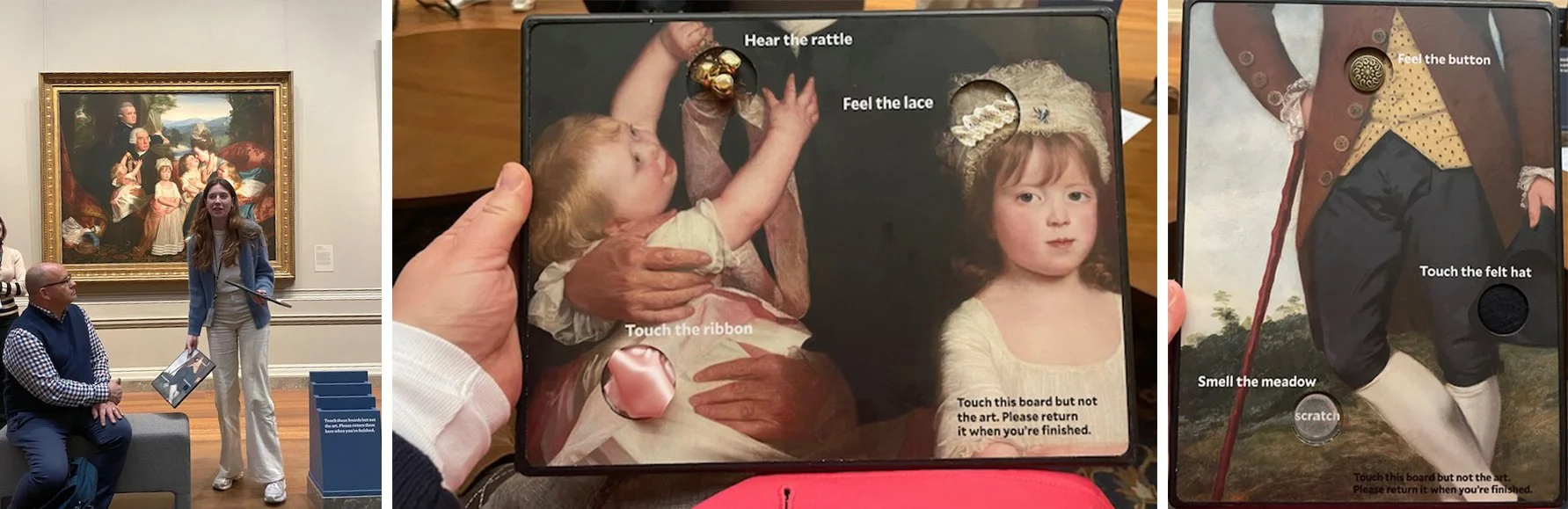
Cassandra Anderson, Interpretive Programs Manager at the National Gallery of Art (left image), introduces the tactile interpretive boards in the American galleries. This innovative visitor experience invites guests to engage their senses by touching textures, smelling scents, and exploring the artwork's intricate details, fostering a slower, more immersive connection with the pieces.
These approaches are intentionally simple. Their purpose is not just to deliver more information, but to encourage visitors to slow down, observe carefully, and engage creatively with what they see.
Many of these experiments are also prototypes for a future reinstallation of the West Building. In that sense, the galleries are functioning not only as exhibition spaces, but also as ‘laboratories for interpretation’. I can wait to see it!
A Museum Designed for Encounter
Taken together, these visits reveal an important shift in museum thinking. The most significant work happening in museums today may not be only what is displayed, but also how the encounter itself is designed. From accessibility to emotional engagement to participatory interpretation, today’s museums are rethinking how visitors move through space, connect with objects, and construct meaning.
What a hopeful experience Day 4 brought! Museums are evolving, and their future may hinge on designing experiences that invite visitors not only to look but also to feel, reflect, and participate.
Footnotes:
(1) Keltner, D. (2024). Awe: The New Science of Everyday Wonder and How It Can Transform Your Life. Penguin Books
Big Thanks to:
Shannon Baldidi, Manager of the Youth and Teacher Program | National Art & Space Museum
Ashley Hornish, Exhibit Designer | National Art & Space Museum
Nathalie Ryan, Senior Educator, Learning & Engagement | National Gallery of Art
Cassandra Anderson, Interpretive Programs Manager | National Gallery of Art
Paula Lynn, Head of Visitor Evaluation | National Gallery of Art
Joanna Marsh, Head of Department of Interpretation | National Gallery of Art
Marie Hofer, Interpretive Project Manager for A250 | National Gallery of Art