Education as system, skill, and design responsibility in modern museums
As we move deeper into the museum world, one purpose keeps returning to the center: education. Museums collect, preserve, interpret, and exhibit, but their public value ultimately depends on how effectively they help visitors learn, question, and connect with what they encounter. (1)
Day five of the seminar revealed this mission from two complementary perspectives during visits to the International Spy Museum and the National Museum of Asian Art. Although these institutions differ dramatically in theme and atmosphere, both demonstrated that museum education is not limited to tours or programming. It is an institutional practice that depends on thoughtful design, interpretive strategy, and skilled facilitation.
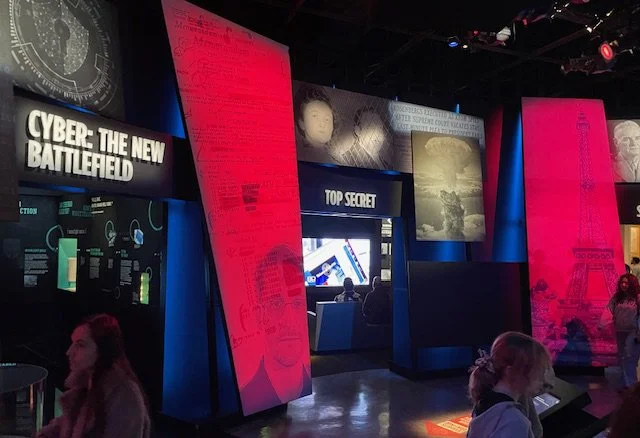
Interior view of the galleries at the International Spy Museum, where immersive graphics, layered media, and interactive stations introduce visitors to the complex world of espionage and intelligence.
Museum Education as an Institutional System
At the Spy Museum, Lucy Stirn, Director of Youth Education, offered a revealing look at what it takes to build learning into a museum experience. Her discussion moved beyond programming alone and into the practical realities of museum education: formative and ongoing evaluation, attention to multiple learning styles, digital and virtual outreach, accessibility planning, adaptation after moving to a new building or during COVID, and the constant challenge of helping visitors navigate a dense and emotionally charged topic: what it means to be a spy.
What stood out most was the museum’s willingness to acknowledge what did not work. Some interactives proved too complicated. Some layouts created confusion. Some spaces slowed visitors down in unproductive ways. In response, the museum revised content, removed or simplified experiences, adjusted tactile components, shortened videos, and used evaluation findings to improve visitor flow.
That kind of responsiveness reflects an important educational principle: learning experiences are not finished when they open. They must be tested, observed, and refined. While formative evaluation is ideal for improving experiences before launch (1), museums must remain willing to adapt as new challenges emerge.
The Museum Educator as Facilitator
At the National Museum of Asian Art, educator Lindsay McAuliffe demonstrated the human side of museum education through a carefully structured bespoke tour.
One of those considerations is that the tour focused on just three works of art, which allowed for in-depth observation, discussion, and interpretation. By using prompts like "What do you notice?" and "What makes you say that?" McAuliffe encouraged participants to observe carefully and share their own thoughts before reading labels, and she provided additional context. Approach not only provides a collaborative learning environment but also equips visitors with tools to continue their exploration independently.
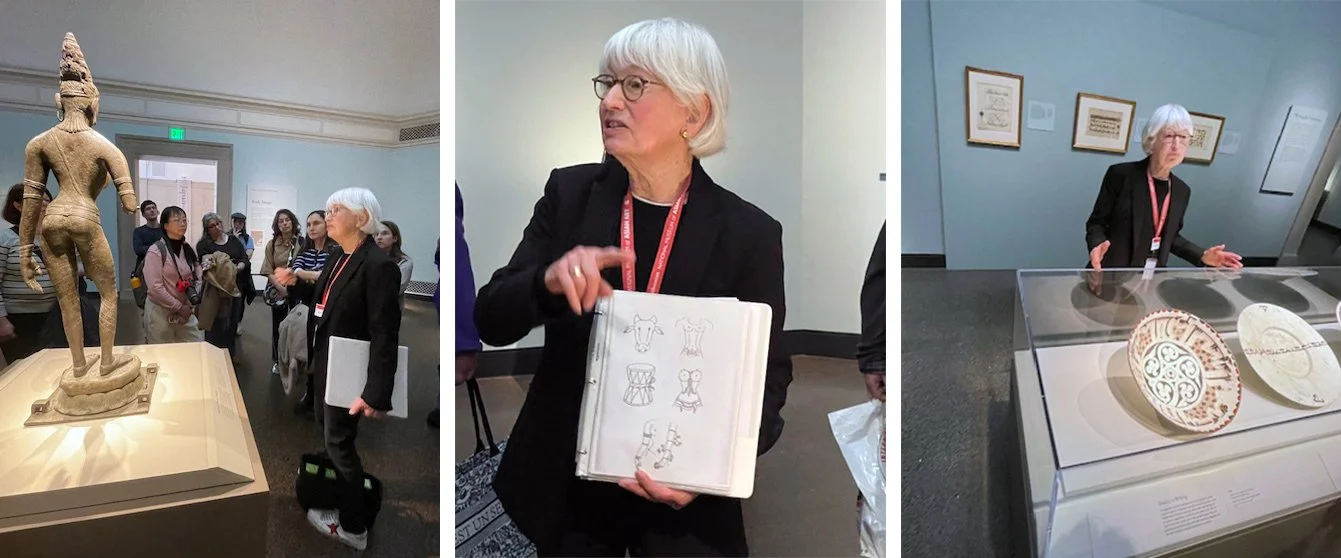
Left: Queen Sembiyan Mahadevi as the Goddess Parvati. Center: Educator Lindsay McAuliffe uses visual aids to explain the layered symbolism found in South Asian iconography. Right: The Beauty in Writing, an everyday plate whose decorative script becomes a gateway to discussing the cultural meaning embedded in daily objects.
It is important to emphasize that her pacing and ability to link historical narratives with contemporary perspectives demonstrate several key skills expected of museum educators: effective communication, cultural awareness, adaptability, storytelling abilities, and the capacity to design engaging and participatory learning experiences. (2)
Witnessing this process in action made it clear that another key factor about museum education is that it is not simply about delivering information. It is about cultivating curiosity and empowering visitors to build meaning through dialogue and observation. (3)
Museum Lens: Designing for Learning
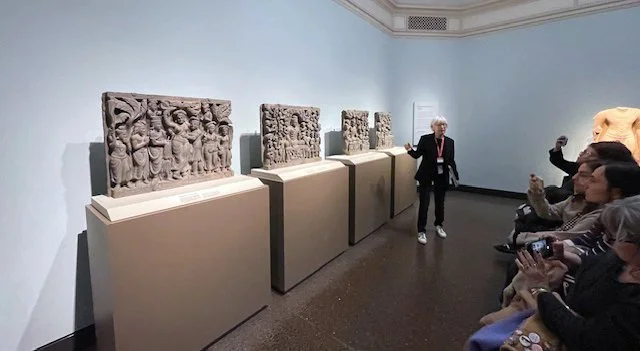
Educator Lindsay McAuliffe guiding close observation of the relief panels Four Scenes from the Life of the Buddha. The image also highlights an important design element for participatory gallery learning: the seating arrangement, which encourages visitors to slow down, engage in dialogue, and focus on careful looking.
From a design perspective, the day raised an important question: if education is central to a museum’s mission, how effectively does the physical environment support learning?
The Spy Museum’s opening prompt: “Are you ready to enter the shadow world?” immediately establishes a powerful atmosphere. Dark lighting, layered spaces, and investigative themes reinforce the underground-espionage theme and draw visitors into the narrative.
At the same time, immersive design must remain balanced with interpretive clarity. While the exhibition was intended to follow a linear path, in practice, some areas felt more open and less clearly directed. When visitors are unsure where to go next, the educational storyline can become harder to follow, creating a tension that highlights an essential challenge in exhibition design: environments must create emotional immersion while still guiding visitors clearly through the learning experience.
Big Thanks to:
Lucy Stirn, Director of Youth Education | International Spy Museum
Lindsay McAuliffe, Educator | National Museum of Asian Art
FOOTNOTES:
(1) Diamond, J., Horn, M., Uttal, D.H. (2016). Practical Evaluation Guide. Tools for Museums and Other Informal Education Settings. (3rd Ed). Rowman & Littlefield.
(2) American Alliance of Museums, (2025). Museum Educator. [Word File]. https://www.aam-us.org/wp-content/uploads/2025/01/Museum-Educator.docx#:~:text=leveraging%20the%20following:-,1.,7.
(3) Johnson, A., Huber, K. A., Cutler, N., Bingmann, M., & Grove, T. (2017). The Museum Educator's Manual: Educators Share Successful Techniques (2nd ed.). Rowman & Littlefield.