Throughout this seminar, I moved through museums as spaces of design, interpretation, and public engagement. I paid close attention to how exhibitions are shaped, how stories are constructed, how visitors are invited in, and how meaning emerges through objects and space.
But on this final day, something changed.
The focus shifted from what museums “show”… to what sustains them.
From institutions… to my place within them.
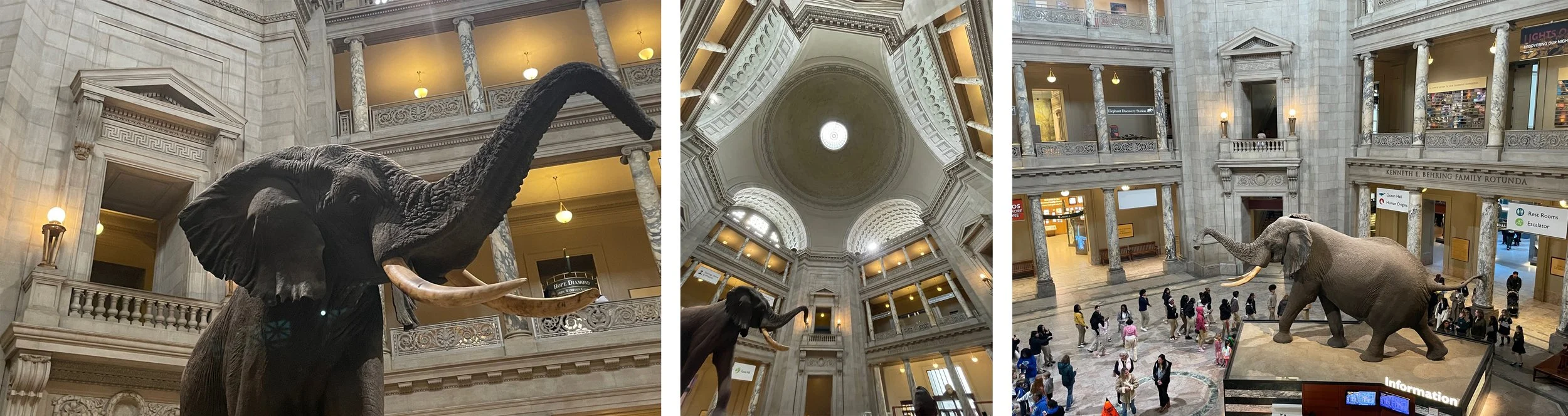
Smithsonian National Museum of Natural History - The Rotunda, anchored by the African Bush Elephant, the largest mounted specimen of the world’s largest living land animal, where scale, architecture, and encounter set the tone for the museum experience.
At the Smithsonian National Museum of Natural History, the conversation with Sara Cronan, Advancement Specialist at the NMNH, expanded to scale. What began historically as a single institution has evolved into a vast, interconnected system. A system where advancement, fundraising, and donor strategy are not peripheral operations, but central to how large museums function. Behind every exhibition is an infrastructure of relationships, resources, and long-term planning that visitors rarely see.
Later, at the DC History Center, that same reality appeared from a very different perspective; smaller in scale, but no less complex. Listening to Autumn Kalikan, the collections manager, reaffirmed how deeply layered this work can be. Collections are not static; they are inherited systems shaped by decades of decisions, limitations, and evolving practices. Every role builds not only on what we do now, but on what others did before us, often with different tools, priorities, and knowledge. I’m pretty sure that alot of museum professionals, or any professional, could relate to that!
Shared Challenges Across Institutions
In here, the contrast between institutions was clear. One operates with global reach and extensive resources. The other works within tighter constraints, negotiating space, staffing, and visibility. And yet, the core challenges were remarkably similar:
Both depend on fundraising and grants.
Both struggle with space (whether expanding or consolidating).
Both must balance the mission across all practices.
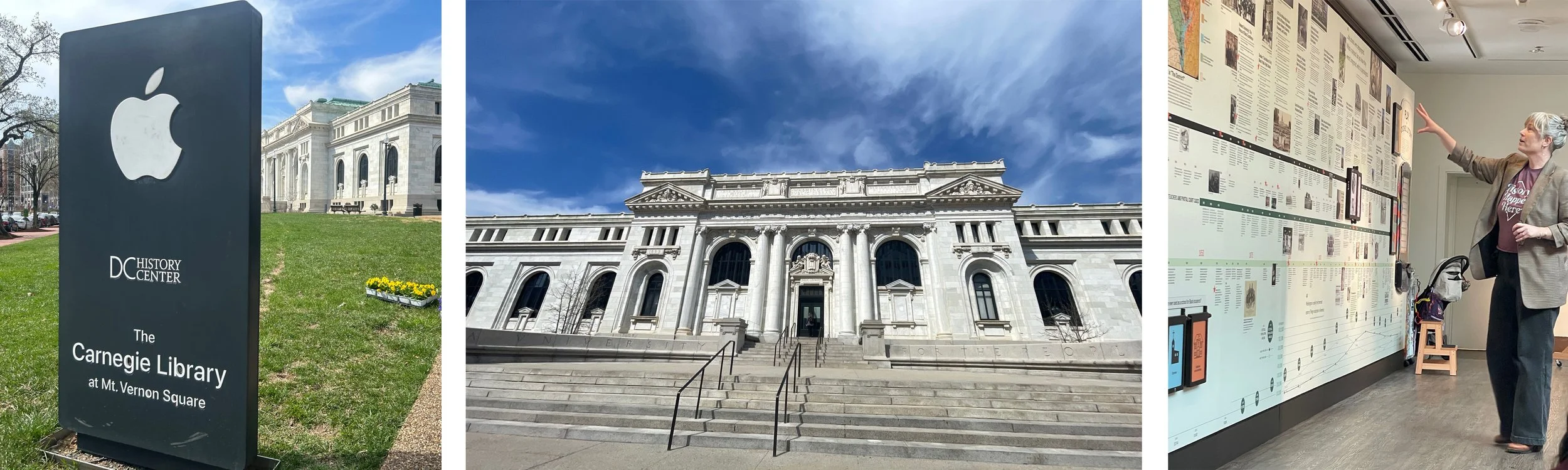
The former Carnegie Library, now home to the DC History Center—operates within a shared building alongside Apple, reflecting layered histories and evolving uses of space.
Right: Anne McDonough, Deputy Director, explains how exhibition design balances narrative, interaction, and spatial constraints in Washington, DC: A Magnet for Black Excellence.
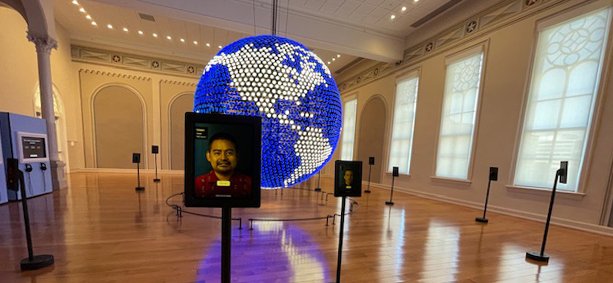
Even exhibitions reflect these realities. As Anne McDonough, Deputy Director at the DC History Center, design decisions were shaped as much by funding requirements and spatial limitations as by interpretive goals. Interactivity, flexibility (with most display cases, objects, and furniture on wheels), and even the absence of original objects were not only creative choices but also strategic ones, allowing the space to transform into an event space at any given moment. A similar strategy was employed by the Planet Word Museum, which I visited yesterday. One of its largest galleries showcases an enormous 3D digital globe that can be converted into a grand salon by retracting this centerpiece, allowing the 12-foot diameter sphere to transform into a chandelier to accommodate events. Once again, adaptability and clever use of space are emphasized.
So, what became evident is that museums are not defined by size, but by how they navigate constraints. How they adapt and how they evolve...
In many ways, this brought me back to the beginning of the seminar, when we first discussed museums operating within broader systems shaped by uncertainty, change, and volatility. At that point, those systems felt distant (conditions institutions had to navigate). Now, they feel closer and more immediate, revealing themselves not only in how museums function, but in how we begin to position ourselves within them.
When Systems Become Personal
Adaptation and evolution unfold not only at the institutional level, but also in our personal and professional lives. And here, a quiet but meaningful connection emerged, mirroring, in some ways, the cherry blossoms unfolding across D.C. as I write this: gradual, seasonal, and impossible to rush.
This idea came into sharper focus during the final conversation of the day, a career talk with Greg Stevens, seminar assistant, and career coaching practice at Purple Cow Career & Talent Development, which brought everything into a more personal register. If museums are complex systems, then careers within them are equally non-linear. Paths are shaped by values, opportunities, and, often, uncertainty. There is no single trajectory, only a process of aligning what we care about with where we can contribute.
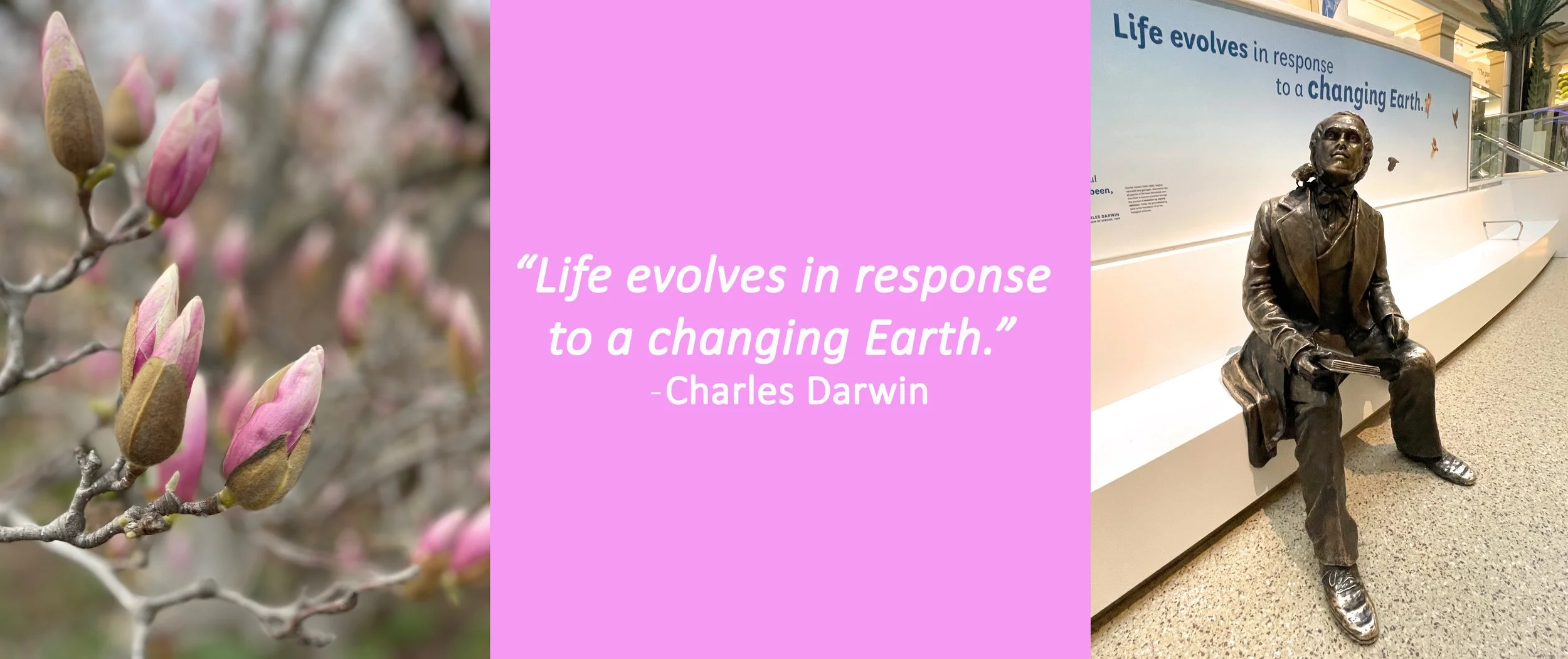
“Life evolves in response to a changing Earth.” —Charles Darwin
Between the early bloom of cherry blossoms and Darwin at the NMNH, evolution feels both visible and personal; an unfolding process shaped by time, context, and change.
Where I Begin...
Over the past couple of weeks, I have entered museums thinking primarily as an exhibit designer, focused on content, space, narrative, and visitor experience. I leave thinking more broadly. Not only about what exhibitions communicate, but also about the systems that make them possible: collections, funding, infrastructure, institutional decision-making, and, last but not least, the vast cross-functional system of museum staff that makes everything possible.
At the same time, this experience did not give me a fully defined path. If anything, it made me more aware of its complexity. What it did offer was something quieter, but perhaps more valuable: a way of seeing where I might begin to position myself within this field.
As someone interested in exhibition design, accessibility, and interpretive planning, I find myself drawn to the intersections: where design meets care, where storytelling meets responsibility, and where visitor experience is shaped not only by what is visible, but by the systems behind it.
Building meaningful museum experiences is not only about what we create. It is about understanding (and contributing to) the structures that sustain them. And perhaps this is not a final answer, but a starting point.
What comes next? Let’s see...or better yet, let’s build something together.
Big Thanks to:
Sara Cronan, Advancement Specialist | Smithsonian NMNH
Anne McDonough, Deputy Director | Smithsonian NMNH
Autumn Kalikan, Collections Manager | DC History Center
Karen Wizevich, Instructor | Johns Hopkins University
Greg Stevens, Instructor | Johns Hopkins University
DC Seminar Series
This post concludes a nine-day reflection series on museum practice, design, and systems developed during my Museum Studies in-depth seminar in Washington, DC. However, the reflections and the work continue…
Explore the full series: