Curating the Visitor Journey at the NMAAHC
This visit made me think differently about how museums shape history, emotion, movement, and choice for visitors. At the National Museum of African American History and Culture (NMAAHC), history is not simply presented. It is carefully structured through narrative, design, ethics, and visitor experience.
Guided through the museum by curator Timothy Burnside, I began to see how closely curatorial work, exhibition design, and visitor engagement are woven together.
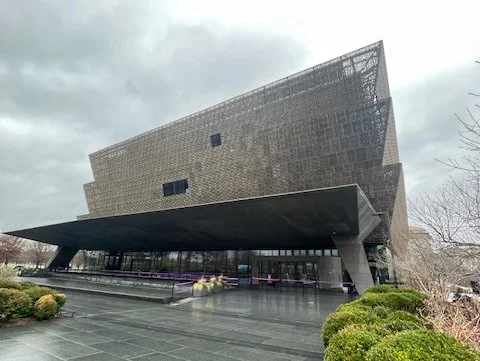
NMAAHC
Approaching the National Museum of African American History and Culture. Even before entering, the building signals that architecture itself plays a role in shaping the museum experience.
Architecture as Narrative
The experience begins almost immediately. From the moment visitors step into the elevator, the narrative quietly starts. As the elevator descends four levels into the History Galleries, the passing years appear on the wall, moving backward in time until reaching the 1400s, where the stories around slavery and freedom begin.
This simple design gesture transforms a functional element into an interpretive moment. You are not just moving through a building—you are moving through time.
Designing the Visitor Journey
Once in the galleries, the museum carefully structures how visitors move physically, emotionally, and intellectually through history. Darker spaces with dramatic lighting draw attention to objects that mark some of the most difficult chapters of American history. Other spaces expand upward, opening into moments of reflection and possibility. One of the most powerful of these moments addresses the museum's “Paradox of Liberty,” in which the ideals of freedom coexist with the reality of slavery.
Every design decision (color, lighting, spatial scale, graphics, and circulation) plays an essential role in interpretation. Architecture and exhibition design do not simply house history here; they actively shape how visitors encounter difficult knowledge, agency, and remembrance.
The visit also reinforced for me how interdisciplinary curatorial work truly is. It is not only about selecting objects. It involves research, collecting, interpretation, cross-departmental collaboration, public programming, conservation awareness, ethical responsibility, and constant attention to the visitor experience.
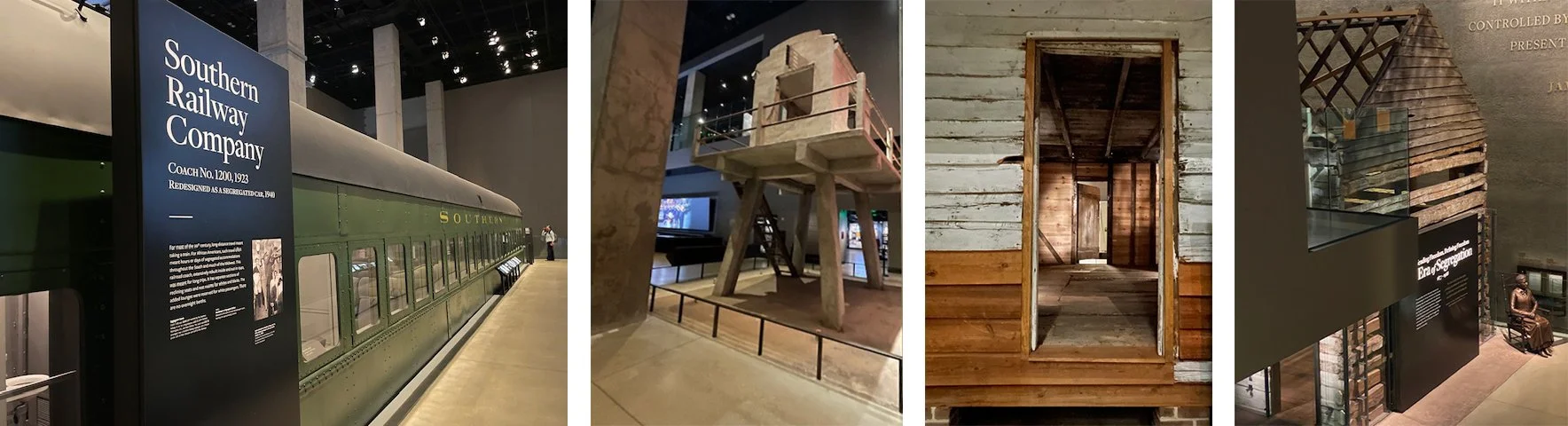
Structural artifacts in the History Galleries at the National Museum of African American History and Culture: the Southern Railway segregated railcar (left), the guard tower from Louisiana State Penitentiary (Angola), the cabin from Point of Pines Plantation (modified after emancipation with the addition of a second door) and the house of J. Marion Sims. Displayed as architectural fragments, these structures transform the gallery into a spatial narrative of control, resistance, and lived experience.
The more closely I looked, the more evident it became that visitor experience is never accidental; it is designed. Museums must balance structured storytelling with the visitor’s freedom to choose how they move through the experience. They must consider how long people can remain engaged, how different visitors learn, and what motivates people to enter a museum space in the first place, something John Falk’s work on visitor identity helps illuminate (1).
Accessibility is also part of this design thinking. Circulation ramps allow visitors of varying mobility levels to navigate the chronological galleries while maintaining the exhibition's narrative flow. I appreciated the thoughtful spatial transitions, seating areas, and moments of pause; reminders that learning in museums is emotional as well as intellectual. Sometimes, I needed to sit, breathe, and let the experience sink in. These small but important moments helped me process and continue, underscoring that museum fatigue is real and that care for visitors matters.
Ethics, Difficult Histories, and Visitor Choice
One small but powerful design detail demonstrates this sensitivity particularly well. In areas where images may be emotionally difficult or disturbing, the museum includes a clear warning sign. Visitors are invited to decide whether they wish to continue. This simple gesture acknowledges that confronting history can be very personal. At the same time, the museum remains committed to presenting the truth and the historical record. Visitors may choose how far they go, but the museum does not hide the facts.

Warning sign
Visitors are alerted when images may be emotionally difficult, allowing them to decide how far they wish to engage with the content.
Museum Lens: Where Design, Curatorship, and Care Meet
For me, this visit became less about any single object and more about understanding the museum as a carefully composed experience. I left with a sense of gratitude for the curators, designers, architects, and everyone who makes spaces like this possible. NMAAHC demonstrates that exhibitions are not only built from artifacts but also from relationships among space, knowledge, emotion, and care. It is at this intersection, where curatorial practice, DEAI, and exhibition design meet, that museum storytelling becomes not just powerful but deeply human.
As someone interested in exhibition design, accessibility, and interpretive planning, I found that this visit also challenged me to think more intentionally about how I might approach my own work in the future. It reminded me that design decisions are never neutral. Lighting, circulation, interpretive framing, and accessibility strategies all shape how visitors encounter history and how they emotionally process what they learn.
Big Thanks to:
Timothy Anne Burnside, Museum Curator - Music & Performing Arts | NMAAHC
Footnote:
(1) Falk, J. (2009). Identity and the Museum Visitor Experience. Routledge