Exhibition Design at the National Museum of American History
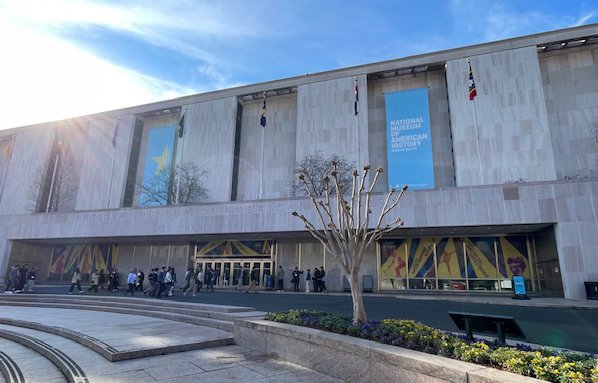
NMAH
National Museum of American History.
Our second day in Washington, DC, began at the National Museum of American History (NMAH), where we met with members of the team behind the museum’s upcoming semiquincentennial initiative, In Pursuit of Life, Liberty & Happiness, opening May 14, 2026.
Because the exhibition has not yet opened, what we encountered was not the final public experience, but something just as valuable, the thinking behind it. Rather than presenting a finished storyline, the team walked us through the curatorial, design, and institutional process of shaping a museum-wide response to the nation’s 250th anniversary.
Curatorial Vision and Institutional Collaboration
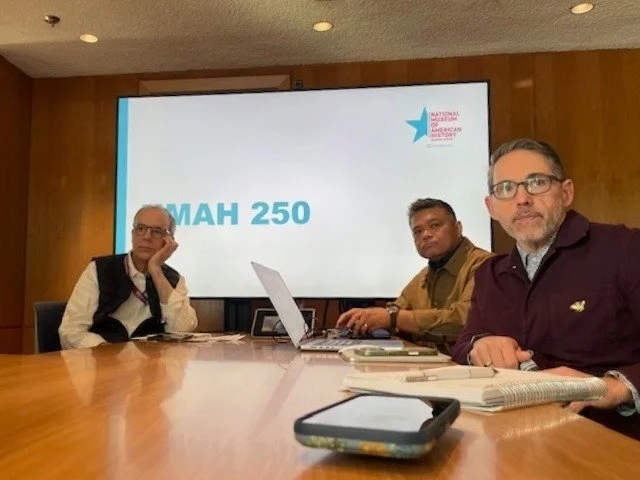
NMAH: Design & Curatorial Team
Howard Morrison, Executive Developer; Theo Goncalves, Curator-Division of Culture and the Arts, and Mike Denison, Head of Exhibit Design.
Just as important was the team’s honesty about the process. They spoke openly about the years of planning involved, the collaborative nomination of objects across divisions, the role of visitor studies in shaping direction, and the constant balancing act between intellectual ambition, staff capacity, conservation realities, and public expectations.
That distinction mattered. This was not simply a conversation about what visitors will see, but about how a national museum decides what it should “say” around this so important event in a unique way. After listening to the Curator Theo Goncalves, from the Division of Culture and the Arts, what stayed with me most was how beautifully the ideas, objects, and design strategies were threaded together. Even in preview form, it felt like a deeply considered curatorial and design effort.
The whole conversation was a reminder that museum exhibition design is not only a creative act, but also an institutional collaboration & negotiation.
Accessibility as Part of Exhibition Design
What also stood out was how accessibility was embedded in the exhibition design process from the start. The exhibition integrates bilingual interpretation in English and Spanish at equal hierarchy, tactile components associated with object displays, and visual descriptions accessible through digital points. More importantly, the team described designing for different ways of engaging, through objects, ideas, people, and immersive experiences.
Digital Interpretation at the National Museum of the American Indian
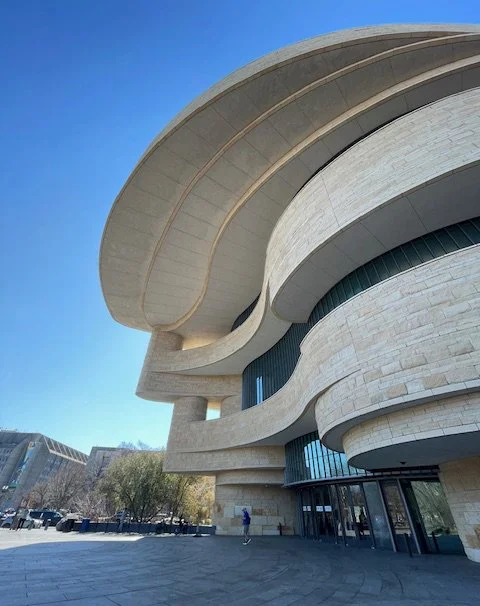
NMAI
National Museum of the American Indian.
In the afternoon, we visited the National Museum of the American Indian (NMAI) and met with Ryan Dodge, Associate Director for Digital Strategy and Engagement.
Here, the conversation shifted from large-scale exhibition planning to digital interpretation in museums. Dodge described technology not as spectacle, but as support. Visitors come to encounter objects, while digital tools expand access to stories, languages, and perspectives that cannot always fit within the physical gallery space.
Object Scanning and Digital Layers of Interpretation
One example is the museum’s implementation of Smartify, a platform that allows visitors to scan objects with their phones to access audio, translations, articles, and extended narratives.
Rather than downloading an app, visitors open a web-based interface that lets them identify objects directly using their phone’s camera. The technology functions like a digital layer beneath the exhibition itself. Visitors who want a quick overview can rely on the physical display, while those seeking deeper engagement can access additional interpretation.
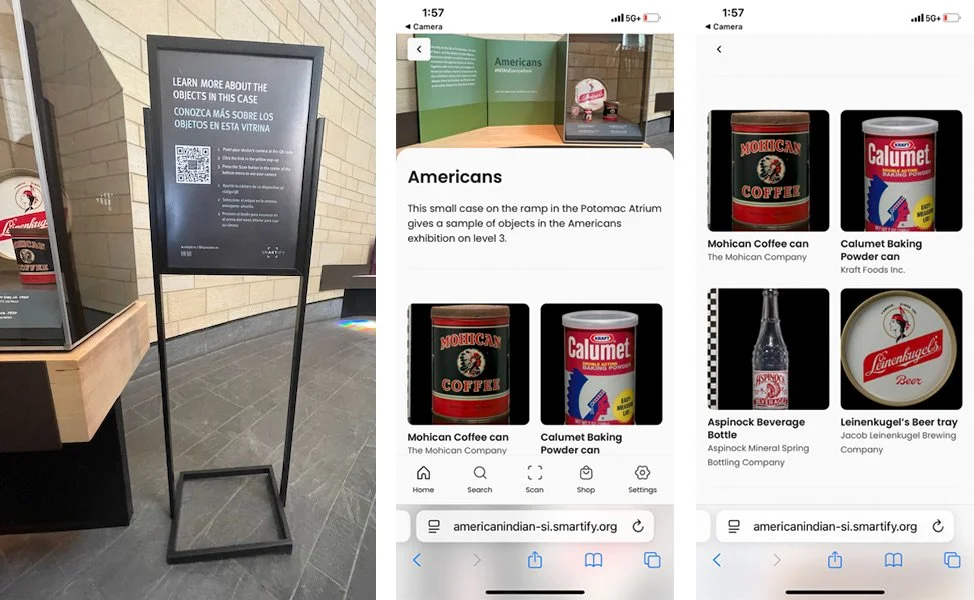
Using Smartify: Scan the QR code, point your camera at the displayed object, and access extended interpretation instantly.
Big Thanks to:
Howard Morrison, Executive Developer | National Museum of American History (NMAH)
Theo Goncalves, Curator, Division of Culture and the Arts | National Museum of American History (NMAH)
Mike Denison, Head of Exhibit Design | National Museum of American History (NMAH)
Ryan Dodge, Associate Director for Digital Strategy and Engagement | National Museum of the American Indian (NMAI)