From Interaction to Intention: Planet Word Museum
At Planet Word Museum, our conversation with Jennifer (Jen) Gambione, Senior Manager of Curatorial Affairs, revealed a museum shaped by deep research, modular design, and constant evaluation.
As we moved through the galleries, what at first felt playful (voice activation, storytelling, immersive language experiences) quickly revealed itself as something much more carefully constructed. The interactives are engaging and often delightful, but they are not there just for novelty. They are built to support literacy across ages, interests, and different learning styles. Diversity and inclusion were cleverly marked by experiences with different languages around the world, or by the ways American English was shaped by those influences.
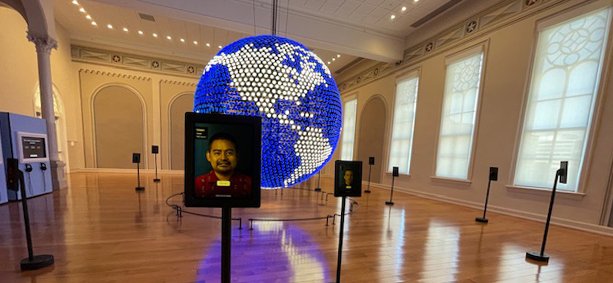
An interactive journey through global languages at Planet Word, where sound, meaning, and connection come to life.
What I found especially meaningful was Jen’s openness about the museum’s ongoing evaluation process. She spoke about questions that continue to shape the work: What are visitors actually using? Where do they linger, and where do they move on? How can content be updated or expanded without redesigning the entire museum?
This made me think about accessibility not as a finished feature, but as something active, observed, tested, and continuously refined. Planet Word clearly operates with that mindset. Still, gaps remain: limited Braille, evolving audio description, and moments where discovery-based interactives may leave some visitors unsure how to engage.
Interactivity alone does not guarantee inclusion. A museum can be immersive and visually compelling, and still require intentional access planning.
Accessibility as Culture, Not Just Compliance
That idea deepened at the Smithsonian National Portrait Gallery, where Vanessa Jones, from the museum's Access Programs, reframed accessibility as part of institutional culture, not just compliance.
Rather than a binary approach (accessible or not), she described a spectrum. Accessibility is not only about accommodation but also about representation: who is visible, who is considered, and how people move, learn, and experience space.
This includes practical decisions (clear labels, readable typography, and thoughtful spatial layout), but also deeper ones: ensuring disability is present within collections and narratives.
One idea resonated strongly: accessibility should not be the sole responsibility of one department. It should be carried out across the museum as a shared responsibility. As a designer, this aligns deeply with my thinking. Accessibility is not an add-on; it is a way of designing from the beginning.
Vanessa also clarified an important distinction. Universal design often suggests one solution for all, while inclusive design allows for multiple entry points. A tactile installation, for example, may support visitors with low vision while also engaging children and tactile learners. Accessibility, in this sense, expands how everyone connects.
Planning as an Institutional Practice
Another key thread throughout the day was planning.
At Planet Word, planning allows exhibitions to remain somewhat “flexible,” revisable, and responsive. At the Portrait Gallery, accessibility must be considered early, otherwise it becomes reactive rather than embedded.
This idea continued in our conversation with Im Chan, conservator at the Portrait Gallery. Conservation may seem like a different conversation at first (as a very specialized practice), but that work is also tied to institutional planning. Conservation follows curatorial priorities, exhibition schedules, and long-term preparation. Work often happens years before the public sees the result.
Open Storage and Creative Access
At the Luce Foundation Center, part of the Smithsonian American Art Museum, we encountered a different kind of access.
Through open storage and a scavenger-hunt activity, visitors navigate the collection independently. The experience is less guided, less fixed, and more self-directed.
I wouldn’t define this as accessibility in the same direct sense as earlier conversations, but it offers another form of access, one based on curiosity, autonomy, and approachability. The collection feels less distant, less controlled, and more open to personal discovery.
A Personal Lens: Accessibility as Horizontal Practice
As someone interested in exhibition design, interpretation, and visitor experience, I also see accessibility as a horizontal practice, embedded across the entire process.
It shapes how spaces are organized, how stories are framed, and how visitors move and engage. Once you begin to see through this lens, inclusion becomes impossible to ignore. It does not limit a museum; it expands its reach, strengthens its mission, and deepens its connection with the public.
Accessibility, then, is not an added responsibility. It is part of the institution’s core purpose.
Big thanks to:
Jennifer (Jen) Gambione, Senior Manager of Curatorial Affairs | Planet Word
Sarah Ross, Tour Coordination | Planet Word
Vanessa Jones, Access Programs | National Portrait Gallery
Im Chan, Conservator | National Portrait Gallery
Jessica McFadden, Program Coordinator | Smithsonian American Art Museum