Today’s visits across Washington, DC, to the Korean Cultural Center, Tudor Place Historic House & Garden, and Mt. Zion Cemetery, led me somewhere I was not expecting. What began as an exploration of cultural programming, historic interpretation, and preservation gradually unfolded into a more personal reflection on what it means to carry culture, memory, and professional identity across borders.
This tension, between what is maintained and what is nearly lost, shaped my understanding of cultural work across these sites. Each, in very different ways, revealed that culture does not move forward on its own. It is carried through institutions, through communities, and through people.
Cultural Diplomacy and Recognition
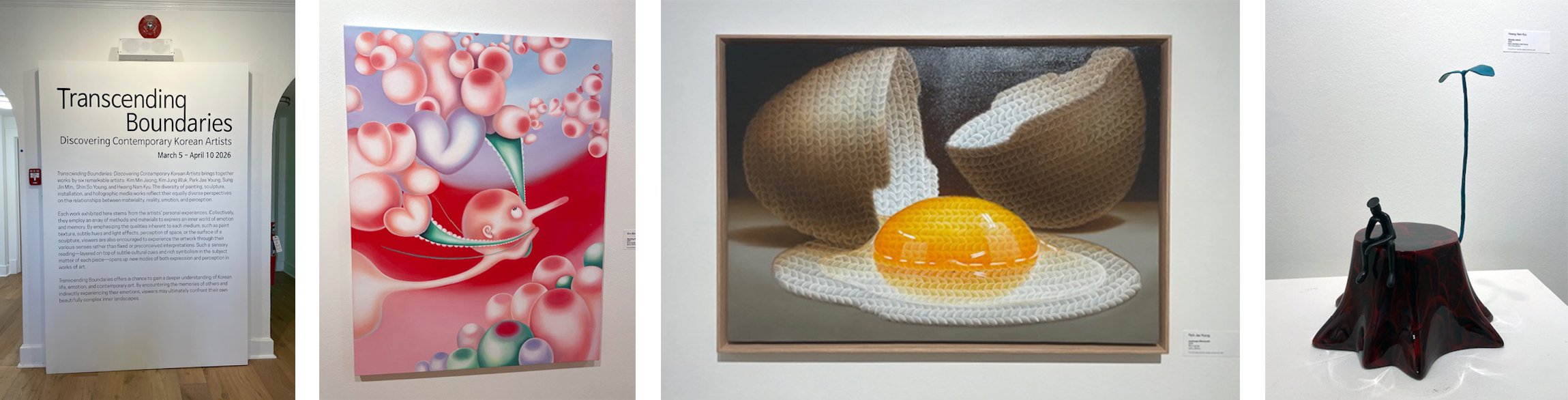
“Transcending Boundaries” at the Korean Cultural Center; featuring works by Kim Min Jeong, Park Jae Young, and Hwang Nam Kyu
At the Korean Cultural Center, conversations around programming and outreach revealed a form of cultural work that felt unexpectedly familiar. Listening to Ji-eun Yun, External Affairs Specialist at the Korean Cultural Center, and guest speaker Nicole Dowd, Head of Public Programs at the National Museum of Asian Art, and observing how partnerships and public engagement were structured, I recognized a professional language I had already learned to navigate. The coordination, the attention to diplomacy, the ability to connect audiences across cultures; these were not abstract concepts. They were practices I had once navigated daily.
For a moment, the distance between my past experience in Venezuela and my present academic path appeared smaller, almost continuous.
Reinterpreting the Historic House
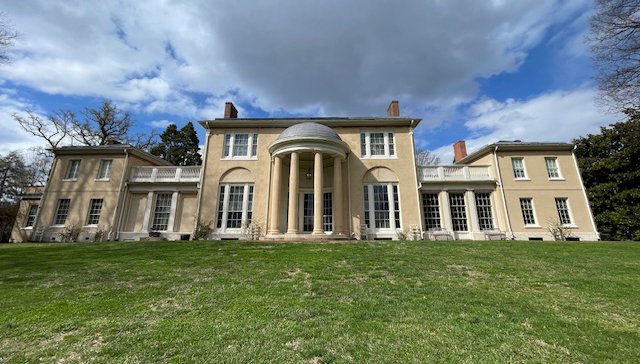
Tudor Place Historic House & Garden, Washington, DC.
That sense of recognition shifted at Tudor Place, where we were guided by Amy Durbin (Director of Education), Shelby Stevenson (Visitor Services Manager), and Justice Finnett (Collections Manager). Their work made something immediately clear: this house is no longer simply about the Washington family legacy; it is about who built, sustained, and experienced that legacy, often without recognition.
Through the most recent exhibition, the narrative expands, centering enslaved persons like Hannah Pope, free Black communities, and immigrant workers alongside the Peter family. The house no longer tells a single story; it reveals a network of lives defined by power, labor, and inequality.
What stayed with me most was how objects were reframed. A punch bowl was no longer only decorative; it became evidence of global trade and systems of exploitation. A garment was not only preserved fabric, but a material trace of inheritance, memory, and even fragmentation. As Justice explained, these objects are not static; they carry histories of use, care, and labor, often by those whose names were not recorded.
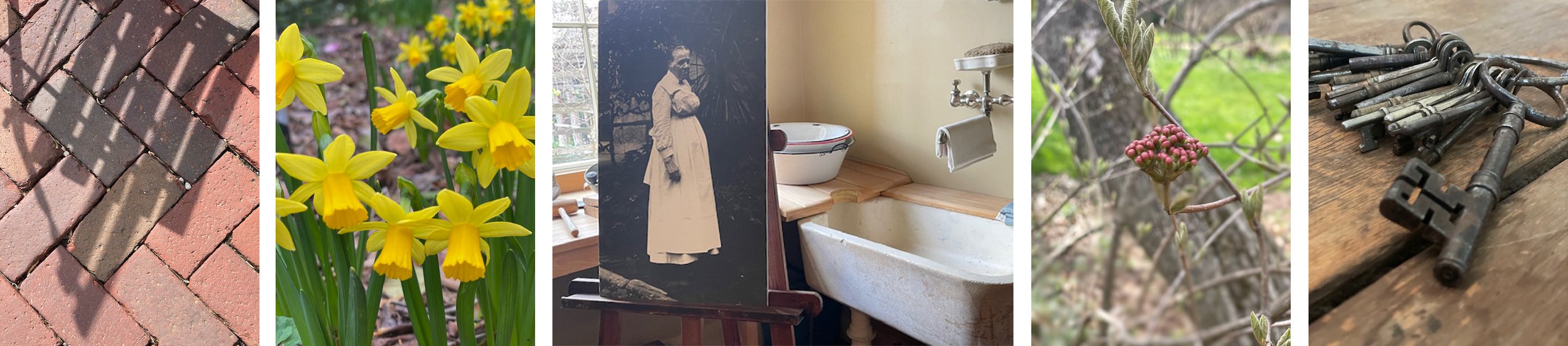
Details of Tudor Place: objects, spaces, and traces of everyday life that reveal the unseen labor, care, and lives that shaped the house beyond its walls.
Memory as Resistance
At Mt. Zion Cemetery, that idea became even more direct. There, we met Lisa Fager, whose work reframes the site not simply as a burial ground, but as an active space of memory and resistance. She described cemeteries as “libraries,” places where stories are held, even when they are not immediately visible...That metaphor stayed with me.
Unlike the structured narratives of museums, this “library” requires effort to read. Many of its stories, of enslaved and free Black individuals, have been overlooked or erased over time. Yet through advocacy, preservation, and community engagement, they have been recovered and are becoming legible again.
Standing there, looking over the hill at the well-organized Oak Hill “white” Cemetery, it became clear that memory does not survive automatically. It survives because someone insists on it.
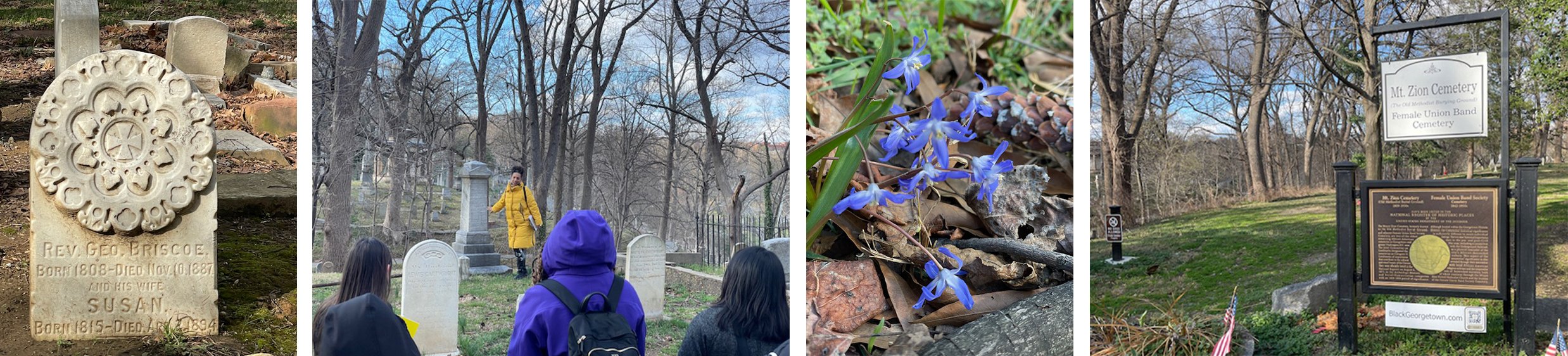
Mt. Zion Cemetery, a “library of memory,” where each gravestone is a book to be read, some with intact covers, others with broken pages, yet all holding histories that refuse to be forgotten. — Lisa Fager, Executive Director, Black Georgetown Foundation
Carrying Knowledge Across Contexts
What began as a series of visits evolved, unexpectedly, into a reflection on professional identity. Migration often creates the impression of discontinuity, of having to rebuild, to reposition, to adapt. But what I encountered across these sites suggested something more precise: not a loss of knowledge, but a shift in its visibility.
Cultural institutions rely on more than collections and exhibitions. They depend on people who can connect contexts, navigate differences, and make meaning accessible across boundaries. In that sense, carrying culture is not only what these institutions do; it is also what we, as individuals moving across contexts, learn to do.
Big Thanks to:
Nicole Dowd, Head of Public Programs | National Museum of Asian Art
Ji-eun Yun, External Affairs Specialist | Korean Cultural Center
Amy Durbin, Director of Education | Tudor Place Historic House & Garden,
Shelby Stevenson, Visitor Services Manager | Tudor Place Historic House & Garden,
Justice Finnett, Collections Manager | Tudor Place Historic House & Garden,
Lisa Fager, Executive Director | Black Georgetown Foundation